
Body Parts in English: The Words from Head to Toe
You need the words for the body more often than you might think: at the doctor when something hurts, when you describe what a person looks like, when you follow an exercise video, and in the dozens of everyday idioms built from body parts. The good news is that, unlike most topics in this series, the names of body parts barely change between American and British English, so learn them once and they travel. This guide goes head to toe, with pronunciation tips for the tricky ones and a few fun idioms along the way.
The head and the face
Start at the top. The head sits on your neck, and your hair grows from your scalp. The front of the head is the face, and these are its parts:
- The forehead is the flat area above your eyes (many Americans say FOR-id, almost "forid").
- Above each eye is an eyebrow, and the tiny hairs along the eyelid are your eyelashes.
- You see with your eyes, smell with your nose, and hear with your ears.
- The soft, fleshy sides of the face are your cheeks, and the point at the bottom is your chin. The bone that lets you chew is your jaw.
- Your mouth has lips on the outside and teeth and a tongue inside.
The neck and upper body
Moving down from the neck:
- Your two shoulders connect your arms to your body.
- The front of your upper body is your chest; the other side is your back.
- Each arm bends at the elbow, and ends at the wrist, just before the hand.
The hand
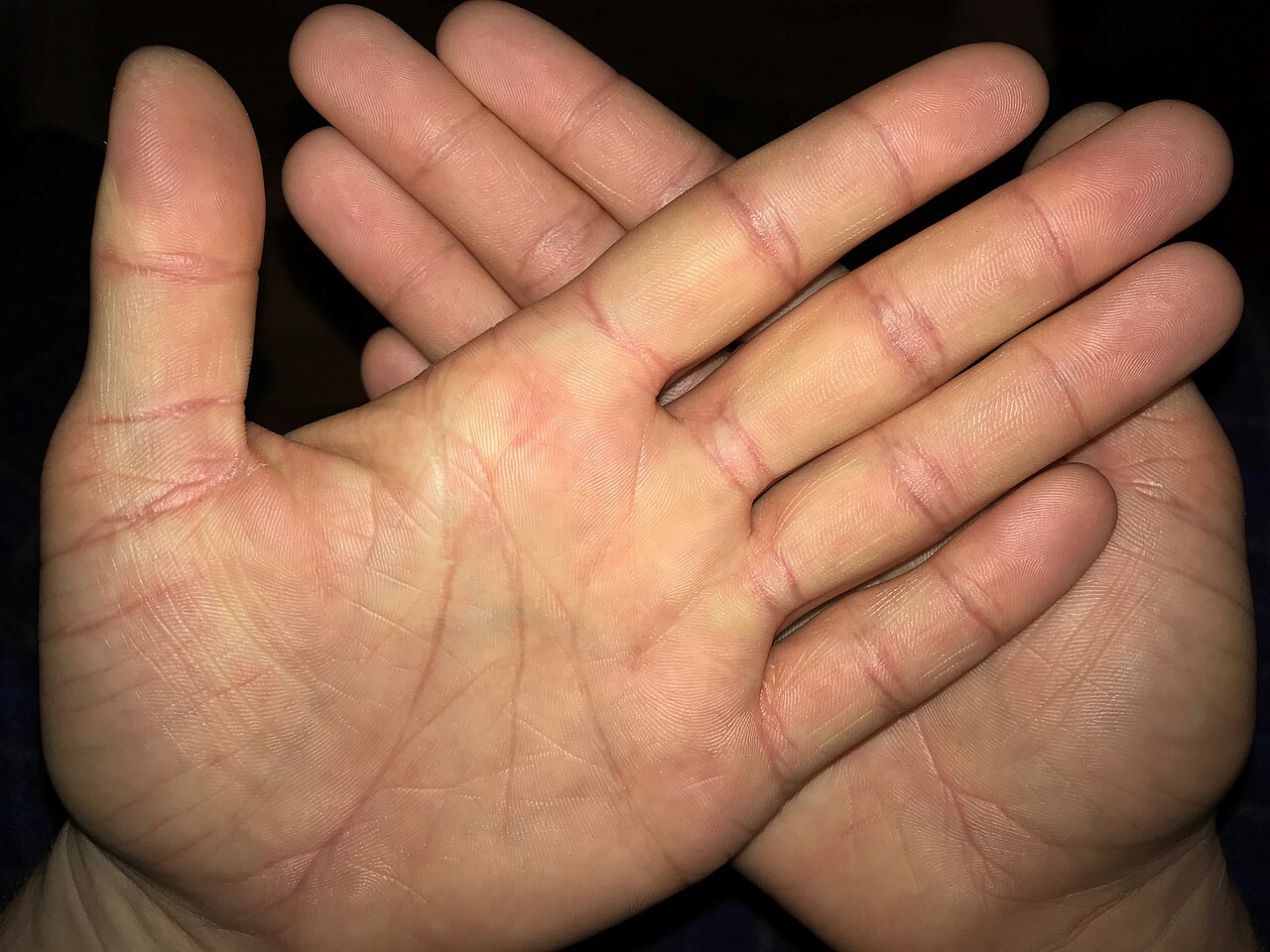
The hand has a surprising number of named parts, and English is precise about them:
- The inside surface is the palm, shown above; the other side is the back of the hand.
- You have four fingers and one thumb. The fingers even have names: the index finger (or "pointer"), the middle finger, the ring finger, and the little pinky.
- Each place a finger bends is a knuckle, and the hard covering at the tip is a fingernail.
The lower body and the legs
Continuing down:
- Your waist is the narrow part in the middle; your hips are the wider part below it.
- Each leg has a thigh (above the knee) and, below the knee, a shin in front and a calf behind.
- The leg meets the foot at the ankle. The back of the foot is the heel, and the front has five toes.
Inside the body
A few words for what is under the skin come up often too:
- Your bones form your skeleton; key ones are the skull (head), the ribs (chest), and the spine (back).
- Your main organs are the brain, the heart, the lungs, and the stomach, and your muscles move it all.
Body idioms worth knowing
Body parts power some of the most common expressions in English. Learn these and you will hear them everywhere:
- cost an arm and a leg = to be very expensive.
- head over heels = deeply in love.
- pull someone's leg = to joke with or tease someone.
- get cold feet = to become nervous and back out of something.
- a pain in the neck = an annoying person or thing.
- see eye to eye = to agree with someone.
Putting it all together
Now you can go from head to toe in English: point to your forehead, cheeks, and chin; name every part of your hand down to the knuckles; and work down through hip, thigh, knee, shin, and heel. Because these words are nearly the same in American and British English, they are some of the most reliable vocabulary you can learn. And when something starts to hurt, you will have the exact word for it, which pairs perfectly with our guide to the doctor and the pharmacy.
Want these words to come out automatically? The collection below turns every term in this article into flashcards and quick quizzes, so you can name any part of the body without hesitating.