At the Airport: The American Words for Air Travel, Explained
We have driven the car and learned the roads. Now we leave the ground. An airport is one of the most stressful places to be a foreign speaker: everything is fast, everyone is in a hurry, and the announcements use words you never meet anywhere else. So let's walk through a whole trip, from the front door of the airport to the moment you pick up your bag on the other side, and learn the word for each step. Where American and British English part ways, you will see the British version noted too.
Buying the ticket
Before you go anywhere, you buy a ticket. If you are flying somewhere and coming back, you buy a round-trip ticket (the British say a return); if you are only going one way and not coming back, that is a one-way ticket. It is worth learning both, because it is the first question the website or the agent will ask you.
Inside the terminal
The airport building itself is the terminal. A big airport has several, numbered Terminal 1, Terminal 2, and so on, and it matters, because they can be a long walk or a shuttle ride apart. Your first stop inside is check-in, the counter (or these days the machine) where you show your ticket, get your boarding pass, and hand over the large bags you do not want to carry. To "check in" is also the verb for this whole first step.
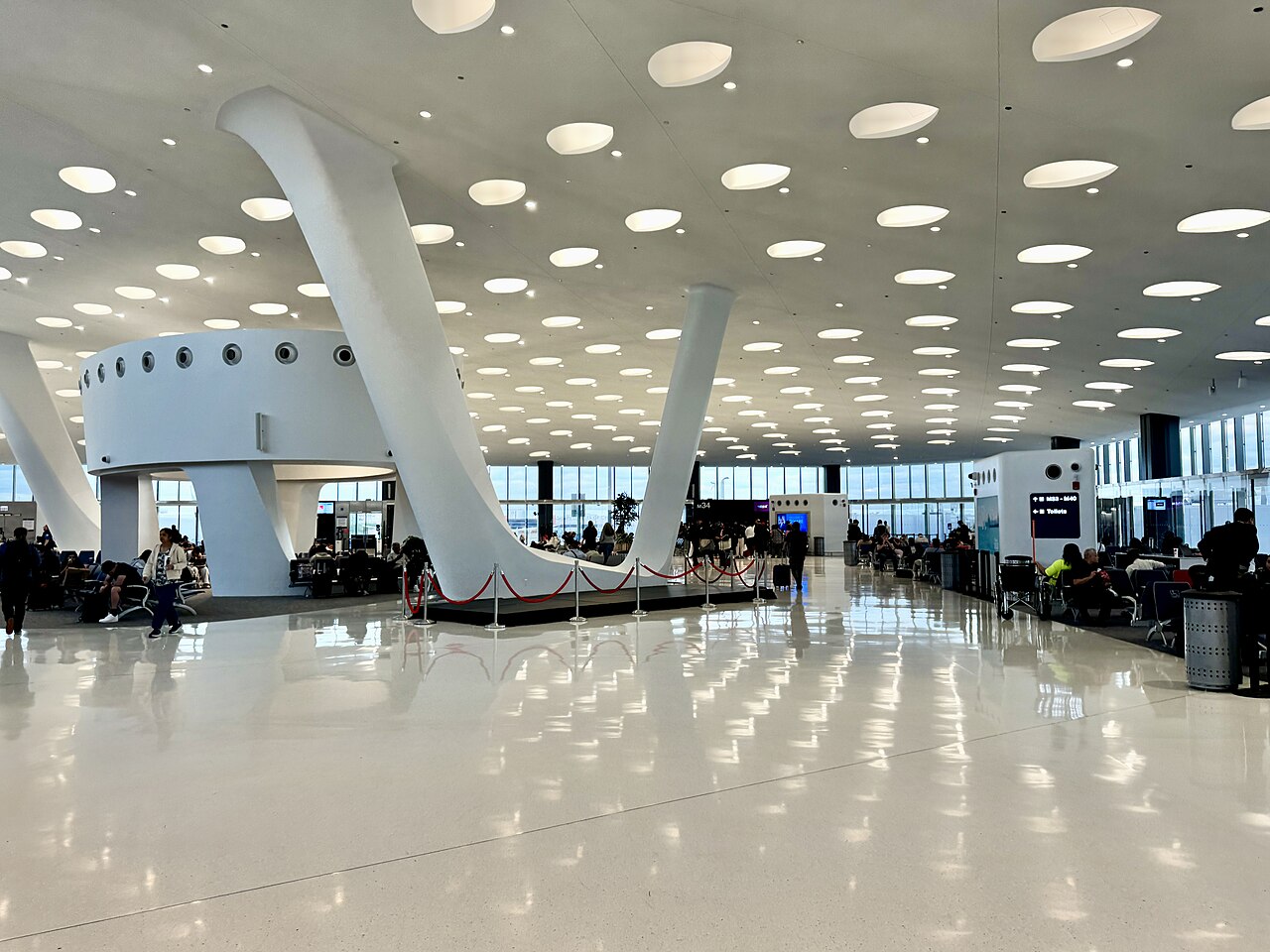
Photo: Warren LeMay / CC BY-SA 4.0, via Wikimedia Commons.
Getting to your gate
Next comes security, the checkpoint where officers screen you and your bags with X-ray machines before letting you through. You take off your shoes and belt, put your things in a tray, and walk through a scanner. It is slow, so people say "get to the airport early to get through security."
Once you are through, you look up at the departures board, the big screen that lists every flight leaving soon, its time, its destination, and, crucially, its gate — the specific door where your plane is waiting and where you will get on board. When the board next to your flight says "Boarding," it is time to go. The small card (or the code on your phone) that lets you through the gate and onto the plane is your boarding pass.
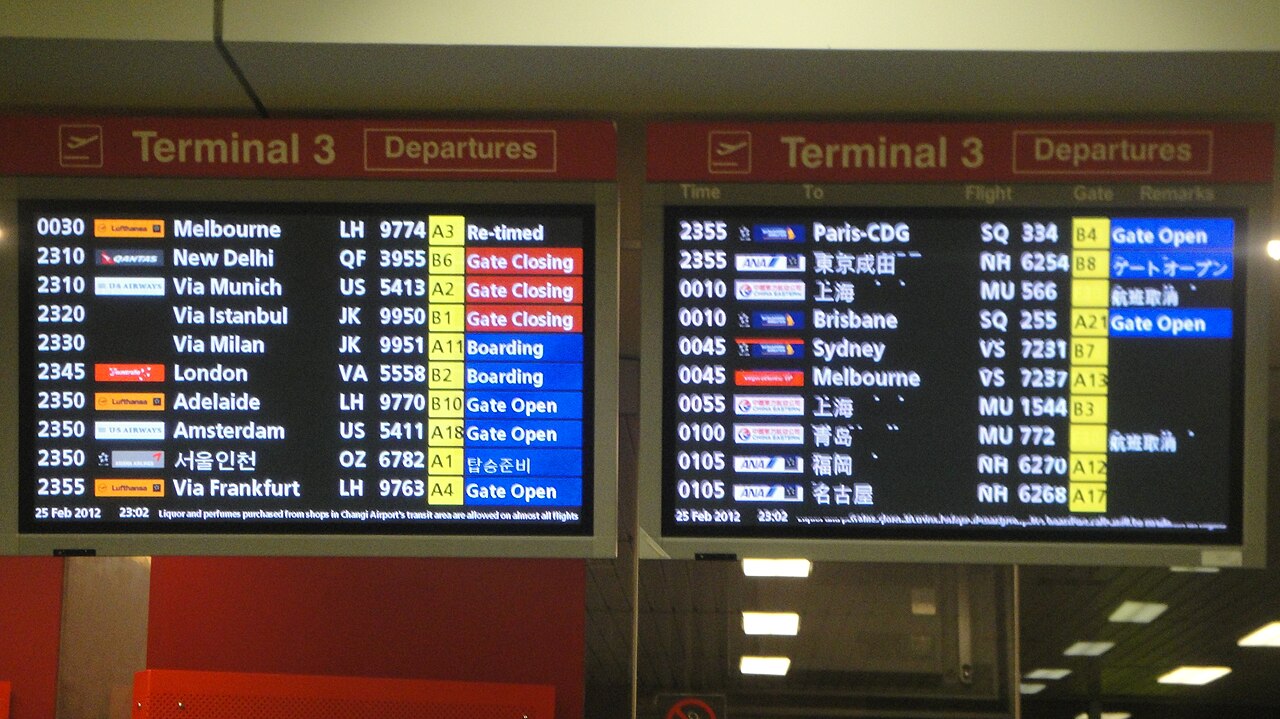
Photo: MasterMind5991 at English Wikipedia / CC BY-SA 3.0, via Wikimedia Commons.
Sometimes you cannot fly straight to your destination and must stop at another airport to change planes. That wait in between is a layover (the British call it a stopover). A two-hour layover is a chance for a coffee; a thirty-minute one is a sprint across the terminal.
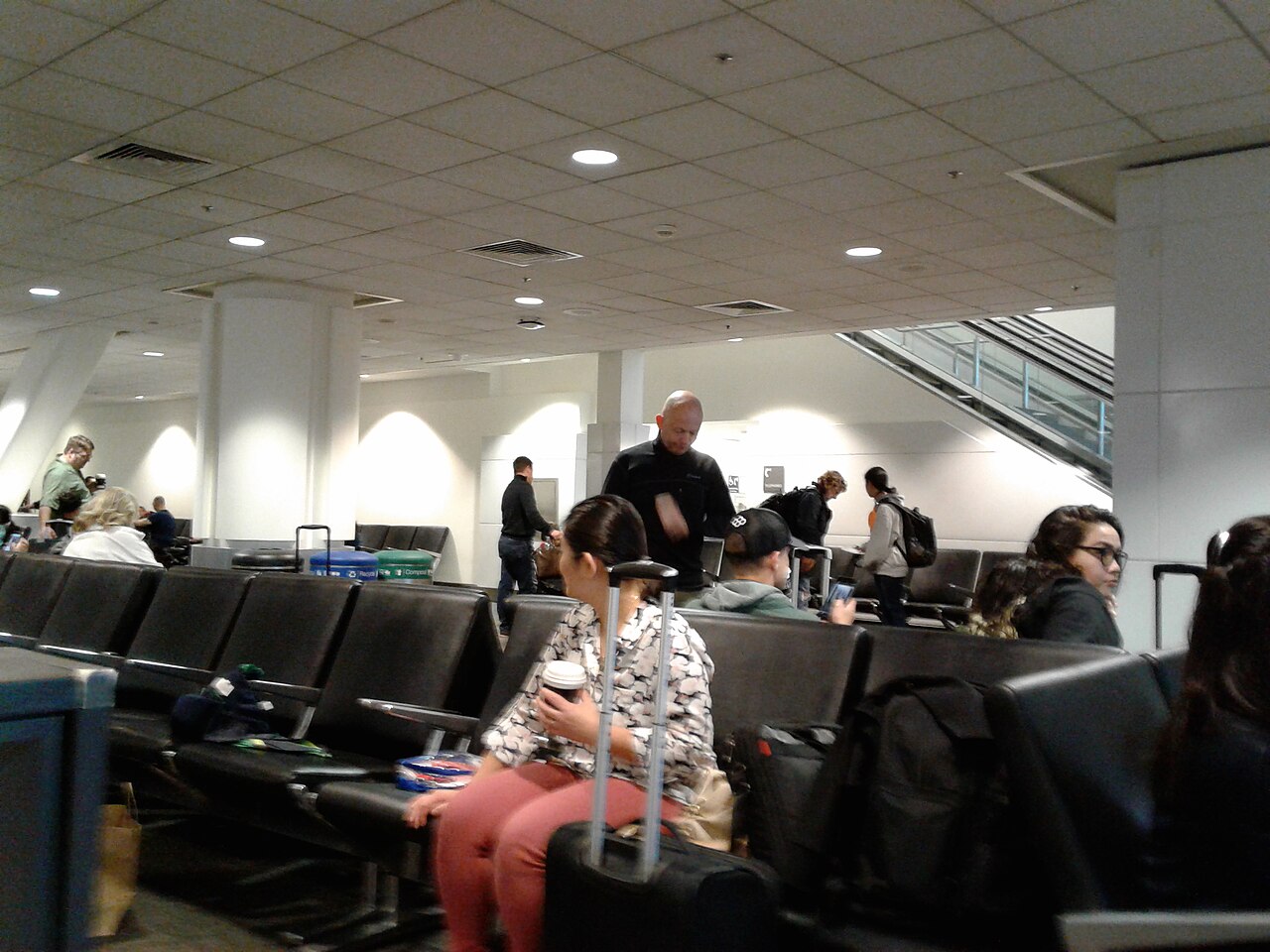
Photo: Buckaroo bob 91 / CC BY-SA 4.0, via Wikimedia Commons.
Carry-on or checked?
Every traveler faces the same choice about bags. A carry-on is the small bag you keep with you and bring onto the plane (the British say hand luggage). A checked bag is the larger one you hand over at check-in; it travels in the belly of the plane, and you collect it at the end. Space on board is tight, so your carry-on goes either under the seat in front of you or up in the overhead bin, the closed compartment above the seats (the British call it the overhead locker).
On board
Now you find your seat. If you like to look out, you choose a window seat; if you like to get up easily and stretch your legs, you choose an aisle seat, next to the walkway that runs down the middle of the plane. (The middle seat, between them, is the one nobody wants.) In front of you, folded up into the seat back, is the tray table, a small flat surface you lower for your drink and your meal. Looking after you during the flight is the flight attendant, the crew member who shows you the safety exits, serves the food, and answers the call button. (In British English they are often the cabin crew or an air steward or stewardess.)
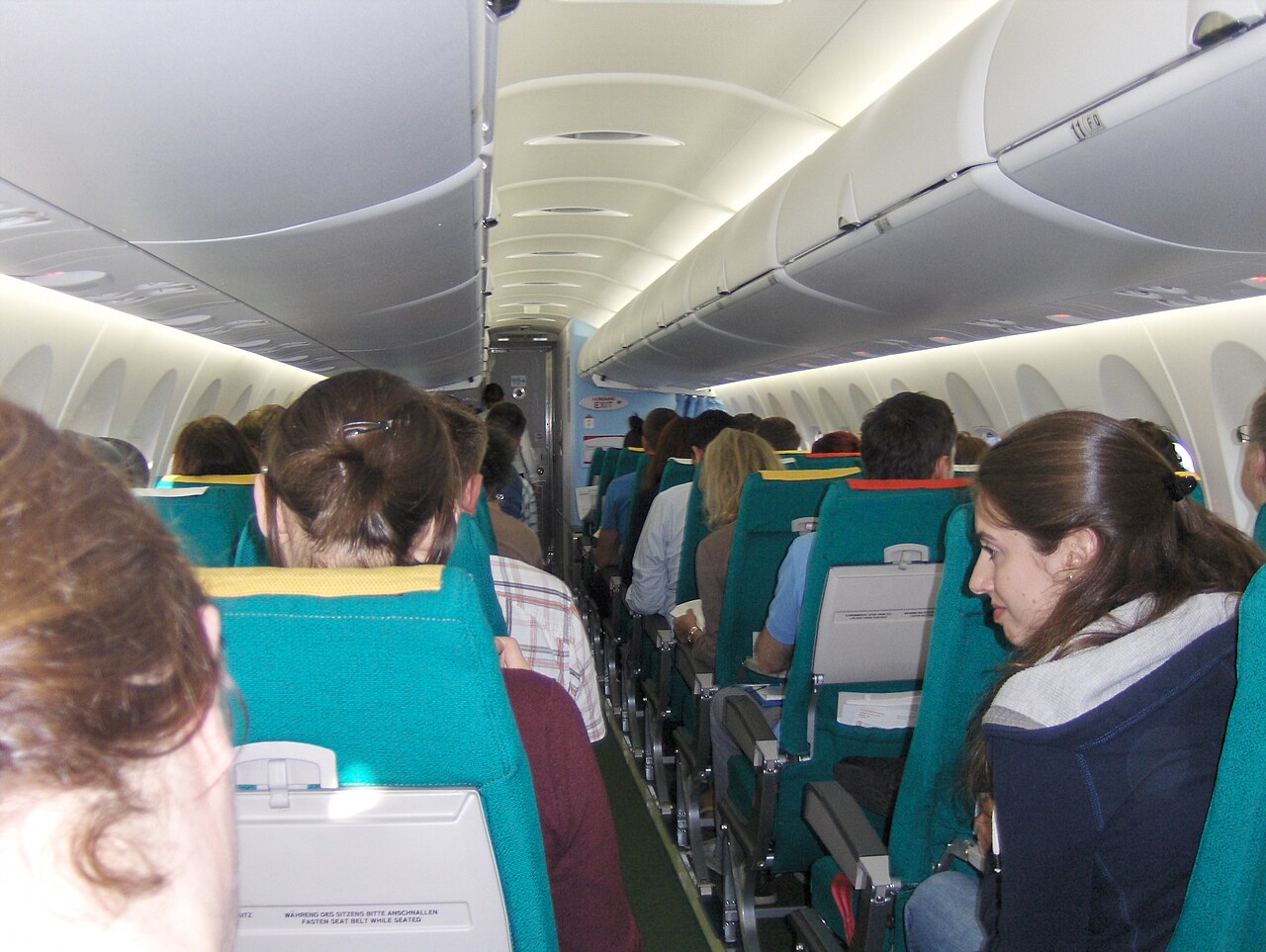
Photo: KOVACIG1 / CC BY-SA 4.0, via Wikimedia Commons.
After you land
You have arrived. Follow the crowd to baggage claim (the British say baggage reclaim), the hall where the checked bags come out. The bags ride out on a carousel, the big rotating belt that goes slowly round and round while everyone leans in, watching for their own suitcase. If you have flown into another country, you must first pass through customs, where officials may check what you are bringing into the country, before you finally walk out through the doors and your trip on the ground begins again.
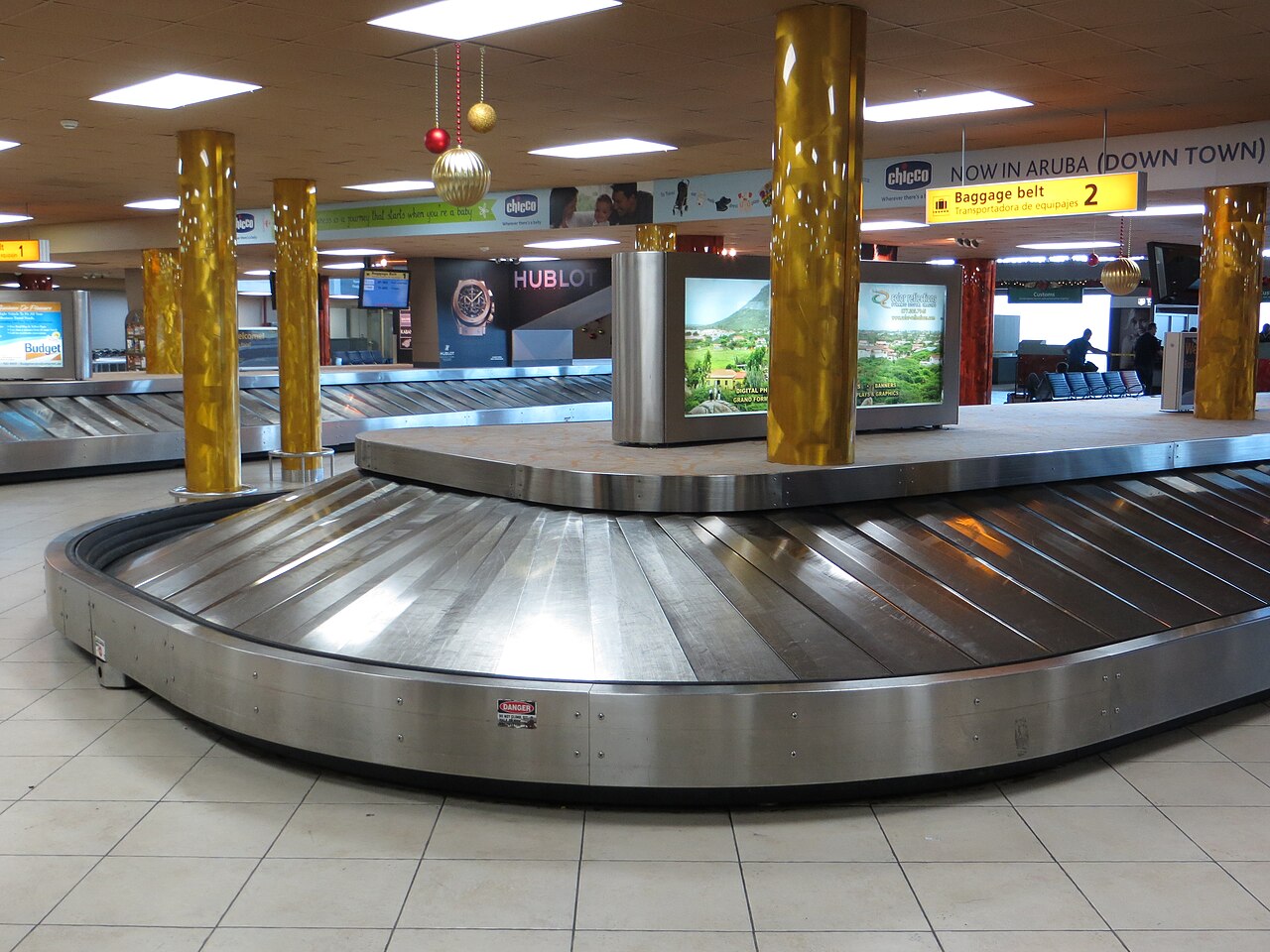
Photo: Sunnya343 / CC BY-SA 3.0, via Wikimedia Commons.
Put the words into play
That is a whole flight, told in the words you will actually hear at the gate and read on the signs. Learn them once and the airport stops being a wall of noise and becomes a series of simple, familiar steps. Open the At the Airport collection above and practice each one in a natural sentence ("I only have a carry-on," "What gate are we?", "Let's find baggage claim"), and the next time you fly, you will move through the airport like someone who has done it a hundred times.